Innovation in Ancient Worlds

Inclusive methods and responsible tech for Ancient Studies

CIAW is a non-profit center supporting teaching and research on the Ancient World—linking philology, epigraphy, archaeology, and ancient history with practical, ethical digital methods.

Foundation

CIAW grew from collaborative teaching and research across universities and vocational IT programs.

Origins: CIAW builds on teaching and research experience developed across multiple institutional contexts, including the Universitat Autònoma de Barcelona (UAB), the Universitat Oberta de Catalunya (UOC), ENTI – Universitat de Barcelona (ENTI-UB), the Universidad Europea de Madrid (UEM), and Kyoto Prefectural University (KPU). These diverse environments—spanning Ancient History, pedagogy, and digital methodologies—shaped the intellectual and institutional framework that ultimately led to the creation of CIAW.

Symposium

Neurodivergent Perspectives in Teaching Ancient History: Innovation, Empathy, and Access

Online Symposium (via Microsoft Teams) — 5 March 2026
Organised by the Center for Innovation in Ancient Worlds (CIAW),
with the support of the Universitat Autònoma de Barcelona (UAB)

Join the symposium on Microsoft Teams

AI & Antiquity organises a yearly symposium devoted to neurodiversity and inclusive teaching practices in Ancient Studies. This programme explores how ADHD, autism, dyslexia, and other cognitive profiles can reshape university pedagogy, assessment models, and student engagement, particularly within disciplines traditionally structured around neurotypical learning standards.

Topics include accessible course design, creative and sensory approaches to learning, assistive technologies, emotional and cognitive engagement with material culture, and the responsible use of AI tools for neurodivergent learners.


Definitive Programme

Date: 5 March 2026 (CET – Spanish time)
Format: Online (Microsoft Teams) — Access link

  • 09:00 – 09:15 | Welcome and Introduction
    Carlos Heredia, Universitat Autònoma de Barcelona
  • 09:15 – 09:45 | The Positive Contribution of Neurodivergence to Ancient Studies
    Jenny Read-Heimerdinger, Institut Catholique de Toulouse
  • 09:45 – 10:15 | Neurodivergent Approaches to Chronology and Narrative in Historiography
    Kenneth Arthur, University of St Andrews
  • 10:15 – 10:45 | The Neurodiverse Teaching the Neurodiverse: Case Studies and Reflections of a Dyspraxic Ancient History Lecturer
    Julia Tomas, The Open University
  • 10:45 – 11:15 | The Relaxed Tutorial Project: Neurodivergent Pedagogy in Classical Studies at The Open University
    Cora Beth Fraser, The Open University
  • 11:15 – 12:00 | Break
  • 12:00 – 12:30 | Somewhere in Time: An Experience in “Living” History (Historia Viva)
    Borja Antela-Bernárdez, Universitat Autònoma de Barcelona
  • 12:30 – 13:00 | The Case Study of the ‘Simulacrum’ in the Latin Learning Process
    Sebastián Altamirano, Universidad de Costa Rica

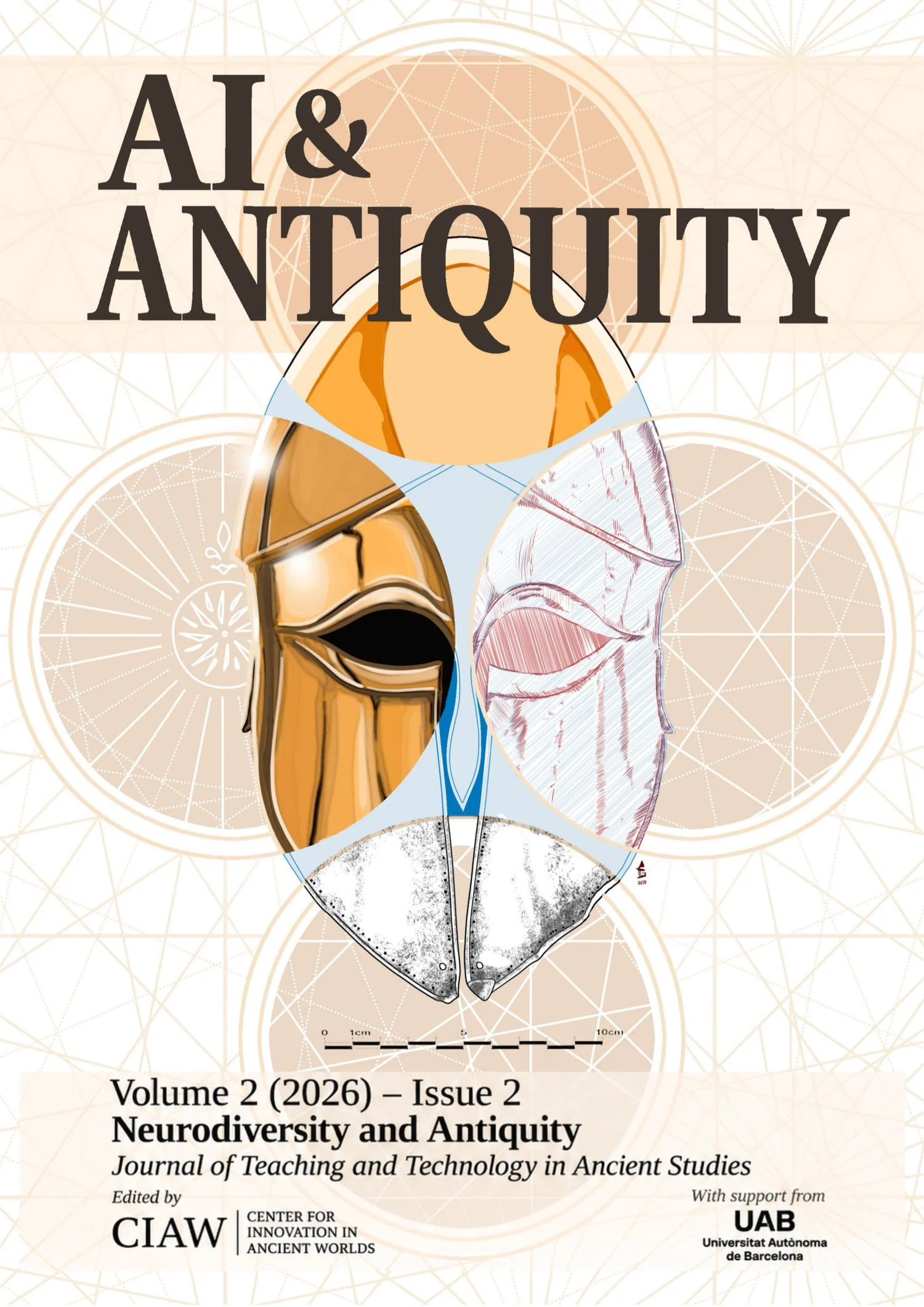
Publication: Selected contributions will be published in AI & Antiquity, Volume 2, Issue 2 (late 2026).

AI & Antiquity

Our open-access journal at the intersection of Artificial Intelligence, inclusive pedagogy, and Ancient Studies.

AI & Antiquity · Volume 1, Issue 1 (2025)

AI & Antiquity: Journal of Teaching and Technology in Ancient Studies (ISSN 3081-4553) is the flagship publication of the Center for Innovation in Ancient Worlds (CIAW). It brings together research on inclusive pedagogy, digital humanities, and the critical and reflective use of AI in the study and teaching of Antiquity.

All issues are published in full open access, reflecting our commitment to accessibility, reproducibility, and intellectual inclusivity across academic and public audiences.

Volume 2, Issue 1Rewriting the Past: Artificial Intelligence, Public History, and Ancient Worlds — is forthcoming (scheduled for late February 2026).

Explore Volume 1 →

Mission

What we do

  • Provide training on inclusive pedagogy for Ancient Studies.
  • Develop open resources for languages, texts, material culture, and data.
  • Offer guidance on responsible AI and reproducible workflows.
  • Connect educators, researchers, technologists, and heritage professionals.
  • Reinvest all support into research, teaching, and community activity.

How we work

We favor practices that are transparent, testable, and adaptable: clear learning goals, small reproducible steps, and tools that reduce friction in teaching and analysis.

Activities

Hands-on formats tailored to the Ancient World.

Workshops & Seminars

Hands-on sessions where participants work directly with primary sources and digital tools. Topics range from text editing and epigraphic transcription to palaeography, archaeological datasets, and ancient languages. Each workshop emphasizes evidence-based teaching methods, encouraging participants to test approaches, reflect on results, and exchange strategies that can be transferred to their own classrooms or research contexts.

Inclusive Resources

We design teaching materials with accessibility as a starting point rather than an add-on. This includes scaffolded lesson plans that break down complex tasks into manageable steps, checklists to support executive function, and multimodal content such as alt-texted figures and captioned clips. Templates for accessible assignments allow educators to adapt activities to diverse cognitive profiles and classroom realities.

Networking & Mentoring

CIAW provides spaces for peer exchange, especially aimed at early-career scholars, teachers, and independent researchers. We foster collaborative groups where methods can be shared, feedback offered, and joint publications developed. Mentoring initiatives connect junior academics with more experienced colleagues, with a focus on pedagogical practice and the dissemination of teaching artefacts that often remain invisible in traditional research outputs.

Experimental Projects

We explore responsible ways of integrating AI and gamification into Ancient Studies classrooms. Rather than relying on technological spectacle, our focus is on game-based activities that foster engagement, critical thinking, and collaboration. Examples include role-playing debates based on historical sources, point-based challenges for text analysis, or reconstructive tasks framed as collective missions. These projects test how playful approaches can enhance interpretation, retention, and inclusivity in learning environments.

Ethics & Methods

Digital tools are never neutral. CIAW organizes forums and produces guidelines that highlight issues of transparency, data provenance, licensing, and bias. We encourage critical reflection on the promises and limits of AI, asking not only what these tools can do but also what they risk obscuring. By documenting methods and making assumptions explicit, we help build a culture of accountability in the digital humanities and Ancient Studies.

Open Publishing

All outputs are made available as open access whenever licensing permits. Beyond journal articles, this includes reproducible workflows, annotated examples, and adaptable teaching packs. Our aim is to reduce duplication of effort and empower educators and researchers to integrate tested methods into their own practice. Open publishing also reinforces transparency and allows the wider community to scrutinize, improve, and reuse our work.

Current Projects

Initiatives we are actively running or coordinating.

Teaching Innovation at Universitat Autònoma de Barcelona (UAB) (2025–2026)

Seminar on Ancient World outreach at the Faculty of Philosophy and Letters, UAB

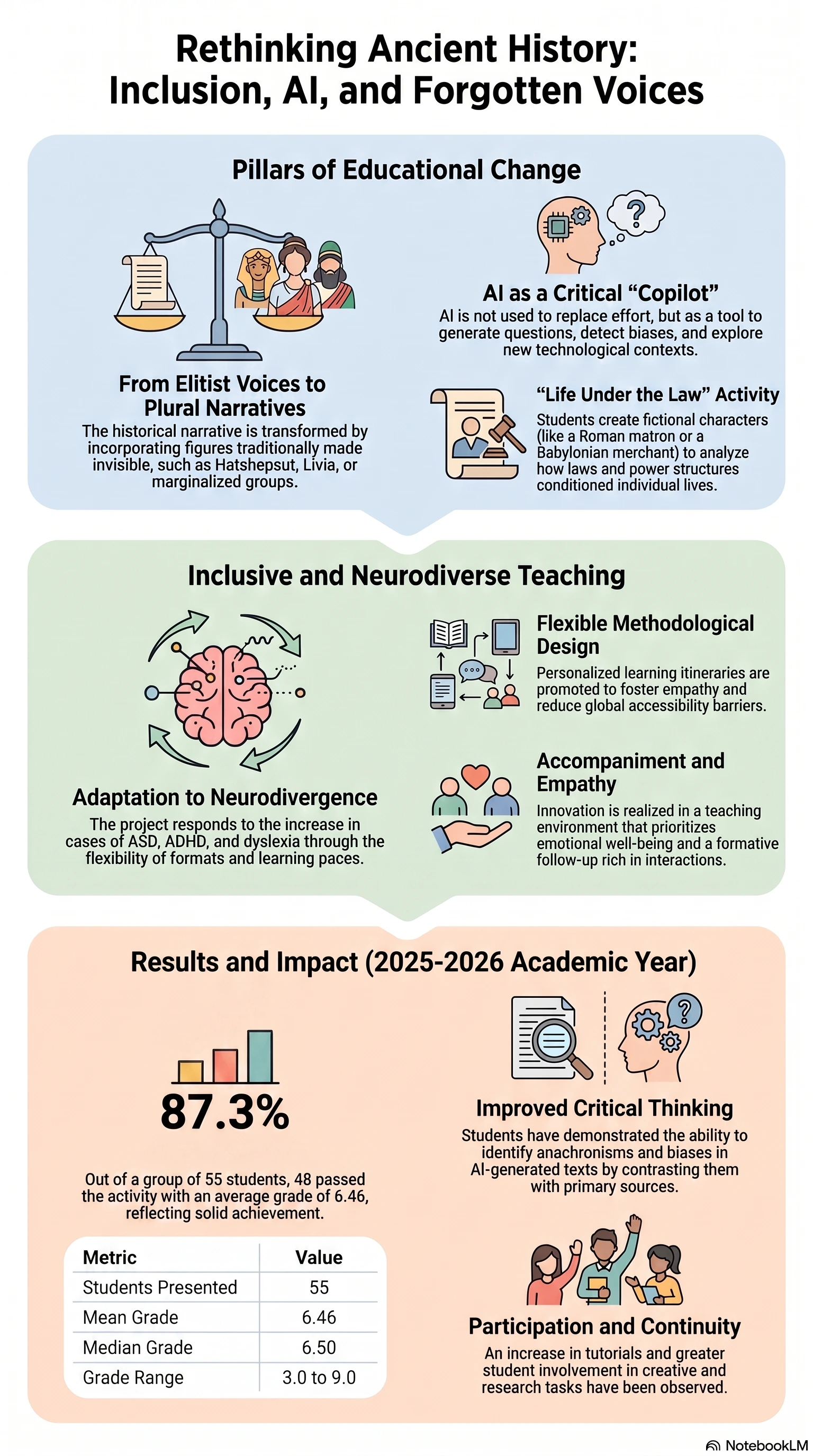
“Forgotten Voices in Antiquity” — a UAB Teaching Innovation Project (GI517492) dedicated to exploring inclusive pedagogy and the critical use of AI in Ancient Studies.

This initiative reconsiders how Ancient History is taught by foregrounding historically overlooked groups and analysing how digital tools — especially generative AI — shape academic content, classroom dynamics, and learning processes. Its approach combines thematic renewal, active learning methodologies, and a reflective, critical examination of technology’s role in higher education.

  • Scope: Implemented across undergraduate courses in History, Archaeology, Humanities, and related programmes.
  • Focus: Integrating marginalized perspectives into course design; fostering critical engagement with AI-generated outputs (bias detection, omissions, narrative distortions); gamified activities to strengthen participation; and supportive strategies for neurodivergent learners.
  • Outputs: Teaching guides, case studies, and adaptable resources made openly available for colleagues and institutions seeking to advance inclusive pedagogy.
  • Method: Small-scale pilots followed by structured reflection, refinement, and dissemination through UAB’s teaching innovation forums.
  • Impact: Enhanced student engagement, improved critical digital literacy, and transferable models for inclusive and accessible university teaching.

Leads (IP): Carlos Heredia & Isaías Arrayás (UAB, Department of Ancient and Medieval Studies).

Inclusive AI Workshops — Faculty of Philosophy & Arts, Universitat Autònoma de Barcelona (UAB)

Seminar on Ancient World outreach at the Faculty of Philosophy and Letters, UAB

“Forgotten Voices in Historical Analysis” — a faculty-level innovation project combining practical training in AI with inclusive teaching strategies.

The project develops workshops for students and staff across History, Archaeology, Humanities, and Ancient Studies. Its aim is to foster critical and creative engagement with AI, highlight silenced voices in historical narratives, and strengthen digital literacy through responsible practices. Neurodivergence and accessibility are built in from the start, ensuring a broad impact on teaching and learning.

  • Scope: Practical sessions across BA programs in the Faculty of Philosophy & Arts.
  • Focus: Bias detection in AI-generated texts and images; reconstruction of narratives from marginalized groups; prompting skills and ethical awareness for students and teachers; inclusive, neurodivergence-aware activities tailored to diverse learning needs.
  • Outputs: An open didactic guide, case-based teaching artefacts, and faculty seminars for dissemination and transferability.
  • Method: Preparation, implementation, and reflection phases (2025–2026), with ongoing feedback loops to refine activities.
  • Impact: Strengthened student participation, improved digital ethics, and new faculty-wide teaching resources for sustainable use of AI in education.

Leads (IP): Carlos Heredia & Isaías Arrayás (UAB, Department of Ancient and Medieval Studies).

AI, Assessment, and Inclusive Pedagogy in the Humanities — Universitat Autònoma de Barcelona (UAB)

Seminar on Ancient World outreach at the Faculty of Philosophy and Letters, UAB

Training programme funded under the Formació a Mida 2025–26 call at the Universitat Autònoma de Barcelona (UAB). The initiative addresses the pedagogical, methodological, and ethical implications of generative AI in higher education, with a focus on continuous assessment, Humanities teaching, inclusivity, and neurodivergence-aware course design.

Courses

  • AI in Continuous Assessment (2025–2026) — completed
    Course delivered to UAB teaching staff working with continuous assessment models. It focused on AI-assisted rubrics, inclusive evaluation templates, multimodal feedback, and accessible task structures for neurodivergent learners.
  • AI in the Humanities: Methods, Ethics, and Inclusive Pedagogy (2026) — upcoming
    New course exploring the critical application of AI across Humanities disciplines (History, Archaeology, Philology, Cultural Heritage, Art History). Topics include source analysis, historiography, digital material culture, epistemological bias, authorship, bibliographic reliability, and academic integrity in AI-supported research and teaching.

Methodology

  • Synchronous online workshops combining live demonstrations and collaborative design.
  • Practical laboratories focused on transferable teaching materials.
  • Structured and multimodal learning environments aligned with accessibility standards.
  • Neurodivergence-aware pedagogical strategies.

Outputs

  • AI-assisted rubrics and inclusive assessment frameworks.
  • Humanities-specific teaching templates and task prototypes.
  • Shared cross-disciplinary repository of resources.
  • Potential pedagogical publications aligned with AI & Antiquity.

Scope: Humanities faculty and teaching staff engaged in continuous assessment and innovative pedagogy.
Leads: Unitat de Formació UAB, in collaboration with the Center for Innovation in Ancient Worlds (CIAW).

Archeion

Seminar on Ancient World outreach at the Faculty of Philosophy and Letters, UAB

Archeion is a dissemination project that uses social media, podcasts, and short-form video to bring Ancient Studies and AI debates to a wide audience.

  • Scope: outreach across Instagram, YouTube, TikTok, and podcast platforms, designed for both general audiences and students without prior specialization.
  • Focus: accessible explanations of AI in education, specialized topics in Ancient History, and inclusive storytelling that highlights women, marginalized groups, and neurodiverse perspectives.
  • Innovation: experiments with engaging formats—narrative podcasts, micro-reels, AI-assisted captions, interactive explainers—while maintaining scholarly rigor.
  • Outputs: visual explainers, narrative podcasts, downloadable packs for teachers, and curated micro-content adaptable for classroom use.
  • Impact: building community around Ancient Studies, fostering critical reflection on technology and history, and democratizing access to academic debates.

Values

Principles that shape how we teach, design, and share knowledge about the Ancient World.

Openness

Open by default. Materials and processes are shared whenever licensing allows.

Open access Shared data Reproducibility

Collaboration

Across fields. Classicists, archaeologists, historians, and technologists work together.

Co-authorship Shared tools Mentoring

Equity

Access first. We design for learners historically excluded from Ancient Studies.

Accessible formats Inclusive rubrics Diverse boards

Critical Reflection

Context before code. We document methods, limits, and biases.

Method notes Ethics checklist Bias audits

Neurodiversity

Inclusive design for teaching and researching the Ancient World.

Neurodivergence—including ADHD, autism, dyslexia, dyspraxia, Tourette, high sensitivity, giftedness, and common co-occurrences—invites better learning design. Many learners face sensory overload, executive-function challenges, or cognitive fatigue in settings built for neurotypical norms. CIAW turns these realities into concrete choices across teaching, events, and digital materials.

Why it matters in Ancient Studies

Dense primary texts, complex grammars, and lecture-heavy delivery can exclude. Neurodivergent strengths—pattern recognition, creative problem-solving, hyperfocus, lateral thinking—improve textual analysis, inscription reading, data modeling, and argument building for everyone.

How CIAW implements this

  • Structured & creative paths: Step-by-step itineraries for clarity; exploratory tasks for divergent thinking (e.g., alternate commentary formats, map-based prompts).
  • Scaffolded materials: Goals first, chunked tasks, time estimates, and checklists for editions, translations, and cataloguing.
  • Sensory-aware delivery: Readable contrasts, captioned media, calm pacing; quiet rooms when possible.
  • Assessment options: Beyond essays: concept maps, annotated corpora, short video briefs, or reproducible notebooks.

The role of AI at CIAW

  • Personalized pathways: Adaptive prompts and templates (structured vs. exploratory).
  • Multimodal access: Visual reconstructions, audio summaries, interactive timelines, layered glossaries to reduce cognitive load.
  • Supportive mediation: AI-assisted summaries, vocabulary helpers, and comparative examples that shift effort from decoding to meaning.
  • Interface comfort: Dark/light modes, adjustable spacing and size, reduced motion, offline packs.

Our commitments

  • Accessible writing & visuals: Clear headings, consistent hierarchy, alt text, captions, legible contrast ratios.
  • Neurodiversity-aware feedback: Actionable, specific, time-bounded comments in workshops and mentoring.
  • Open artefacts: Teaching prompts, rubrics, and student-facing guides shared when licensing allows.
  • Ethical AI: Transparent workflows with notes on limits, bias, and data provenance.

See CIAW resources and templates in our contact section.

Get involved

We partner with educators, departments, and cultural institutions to co-design inclusive activities and materials. To adapt a course, redesign assessments, or run a neurodiversity-aware workshop, get in touch.

Non-Profit Character

Independence & sustainability: CIAW is non-commercial. Support comes from contributions and grants and is reinvested in teaching, research, and community work.

Get involved

Collaborate on courses, workshops, or resources for the Ancient World.

Collaborations

Email (Founder): carlos.heredia@uab.cat

Journal: AI & Antiquity (open access)

Support

We welcome in-kind contributions, micro-grants, and shared expertise. All support returns to non-profit activity.